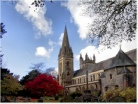

Llandaff is located about two miles north-west of Cardiff City centre and is on an
area of rising ground beside the River Taff. The elongated hill on which it stands
is the remains of a rock outcrop which, in prehistoric times, would have been the
nearest piece of dry land to the sea. The surrounding flat land, such as Llandaff
Fields, would have been swampy marshland, difficult to cross and liable to flooding.
The Cathedral is sited below the rest of the village on a narrow shelf between the
base of the hill and the River Taff. This position was probably chosen because it
was near the old river crossing and was also partly hidden from intruders. The site
would also have been well served by a line of wells and natural springs along the
scarp of the hill.
Immediately east of the Cathedral, the character of the landscape changes to flat,
low-lying and open country. This is the fertile river plain consisting of alluvial
silts and mud deposited by the River Taff as it meandered from one side of the valley
to the other over the centuries. Today the Taff flows down the centre of the valley
about a quarter of a mile to the east of the Cathedral.
When, however, the first Christian missionaries arrived at what is now Llandaff,
the course of the river was probably much further west and very near to the site
of the original church. Indeed, the very name Llandaff (meaning ‘church’ or ‘sacred
enclosure’ by the Taff) implies that this was the case. Early maps show the River
Taff running close to the Cathedral more or less in the position of the mill-stream
that once ran through the centre of the cemetery. By the beginning of the nineteenth
century the river had divided into two watercourses forming a long island between
the Cathedral and the present course of the river. Gradually, as the main course
of the river began to swing eastwards, the western course silted up until eventually
it had contracted to the size of a stream..